01
Automated test systems
Automated bring-up, characterization, regression, and end-of-line workflows built around your DUT, risks, and release criteria.

Hardware test engineering + automation
We design automated validation systems, select the right lab equipment, and build reusable test infrastructure that shortens the path from prototype to release.
Faster feedback
Move repeatable checks off the engineer's clipboard and into automated runs.
Better equipment choices
Buy what the requirements demand, with a plan for integration and growth.
Traceable evidence
Tie results to the DUT, firmware, configuration, operator, and test version.
Safer operation
Build preflight checks, limits, interlocks, and verified safe states into the workflow.
Services
We can solve one painful bench problem or build the full path from requirements and equipment selection through automated execution and release evidence.
01
Automated bring-up, characterization, regression, and end-of-line workflows built around your DUT, risks, and release criteria.
02
Requirements-based instrument selection, equipment BOMs, fixture concepts, harness maps, safety controls, and an integration plan.
03
Connect mixed-vendor scopes, supplies, loads, DAQs, meters, and custom hardware behind a consistent automation layer.
04
Requirements review, risk-based coverage, traceability, test plans, evidence expectations, and a practical execution roadmap.
05
High-voltage and PCBA lab reviews covering procedures, limits, interlocks, preflight checks, safe states, and operator workflows.
06
Senior test leadership plus hands-on implementation for teams that need progress now without adding permanent headcount.
The new development bottleneck
Faster coding and prototyping increase the number of physical builds, firmware revisions, and edge cases that need trustworthy evidence. The test system has to keep pace.
Long Game Testing turns requirements, equipment, bench configuration, automated execution, and results into a repeatable validation workflow.
Turn hardware testing into a competitive advantage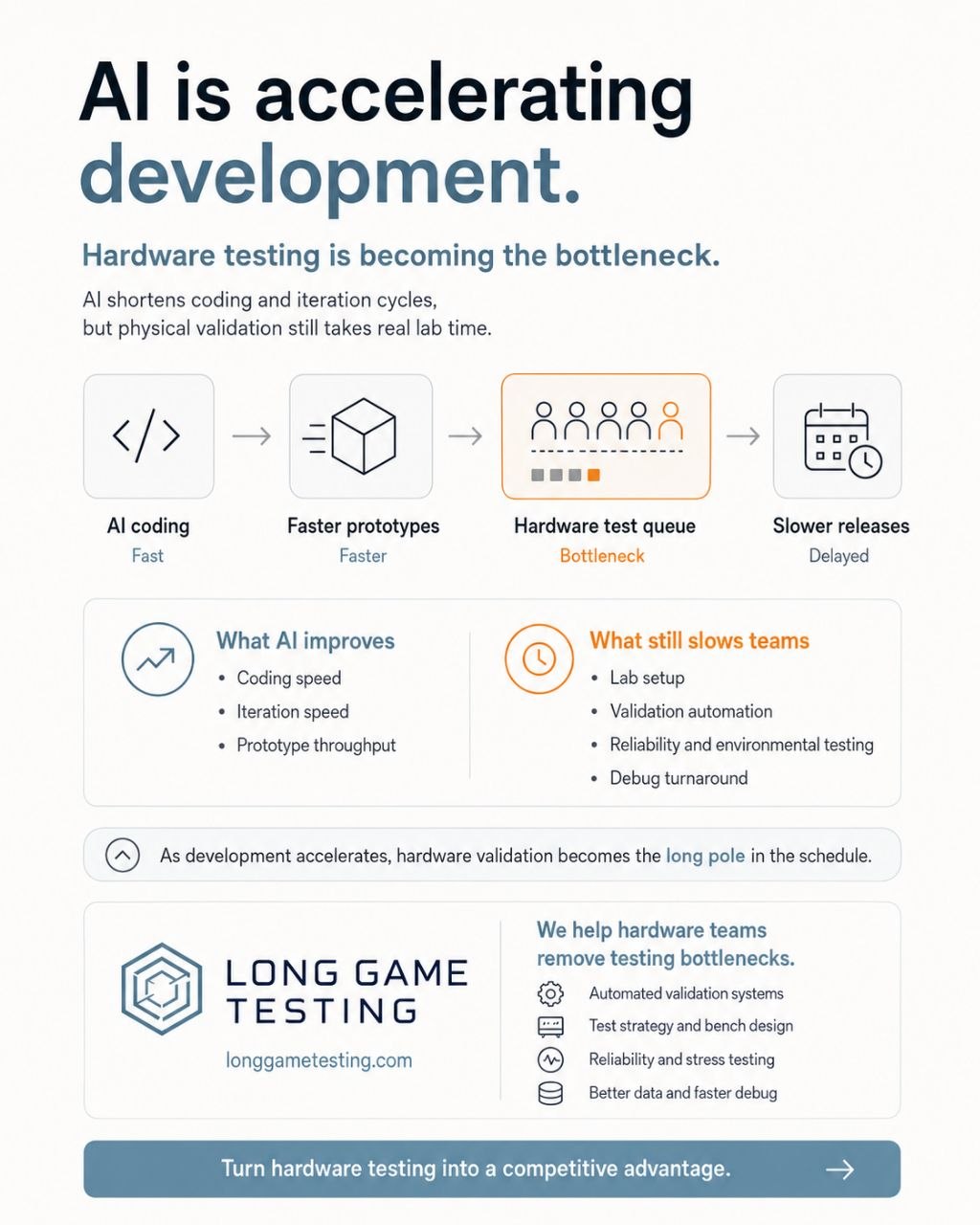
Automation as product-development leverage
Standardize setup, instrument configuration, data capture, and first-pass checks so engineers spend less time rebuilding the bench state.
Run the same characterization and regression checks after firmware, hardware, or calibration changes.
Produce reviewable evidence with known configurations, pass/fail logic, limits, and traceability.
Turn bench knowledge into maintainable workflows instead of leaving it trapped with one engineer.
Long Game test SDK
Our SDK separates stable test workflows from vendor-specific instrument adapters. Supported equipment can be discovered, identified, configured, and controlled through consistent interfaces, so changing a supply or scope does not require rewriting the test logic above it.
Instrument capabilities, commands, limits, and identity rules are captured in validated YAML schemas. A readable bench configuration then maps the equipment, project-defined safety controls, and evidence requirements for each system.
The SDK is an accelerator, not a black box.
We use it to deliver working automation sooner and document the bench clearly. Engagement handoff can include the project source, bench configurations, instrument schemas, automated tests, and operating documentation. Ownership and ongoing support are agreed before the build starts.
bench.yaml
Readable configuration
bench: power_stage_validation
discover: true

instruments:
  supply:
    profile: programmable_psu
    identity: required
  load:
    profile: electronic_load
    identity: required

safety:
  preflight: required
  verified_safe_state: required

evidence:
  capture:
    - dut_serial
    - firmware_version
    - test_version
Discover and map
Inventory supported equipment, verify identity, map capabilities, and create a maintainable bench configuration.
Automate and protect
Control instruments through consistent interfaces with project-defined limits, preflight checks, and safe-state verification.
Capture and scale
Record the context behind each result and reuse the same foundation as products, benches, and teams evolve.
Sample validation package
We use one BMS requirement to show how the test plan, equipment definition, reviewed wiring records, safety gates, and evidence contract come together.
BMS-REQ-002
DVT scenario
Make the physical validation chain reviewable.
Verification plan
Bench definition
Wiring record
Operator brief
Ways to start
Automation opportunity assessment
Review current test flow, manual effort, failure modes, data quality, and release needs. Leave with a prioritized automation roadmap.
Equipment and lab architecture
Translate requirements into an equipment BOM, connection plan, safety architecture, bench configuration, and implementation path.
Test automation readiness diagnostic
Assess an existing bench or hardware-in-the-loop system for flaky automation, setup dependencies, traceability gaps, and safety controls. Get a score, risk register, and 30-day plan.
About
Long Game Testing brings experience earned in test engineering roles at Tesla, ChargePoint, and Form Energy to startups and technical teams that need rigorous validation without enterprise drag.
The work covers high-voltage systems, PCBAs, lab operations, equipment integration, test automation, safety reviews, and fractional engineering leadership.
Best fit for teams building power electronics, EV charging, batteries and BMS, robotics, grid hardware, industrial controls, or other firmware-heavy products where slow bench feedback holds up development.
Start a conversation
A manual bench, unclear equipment choices, missing test coverage, or automation that only one person understands are all reasonable places to start.